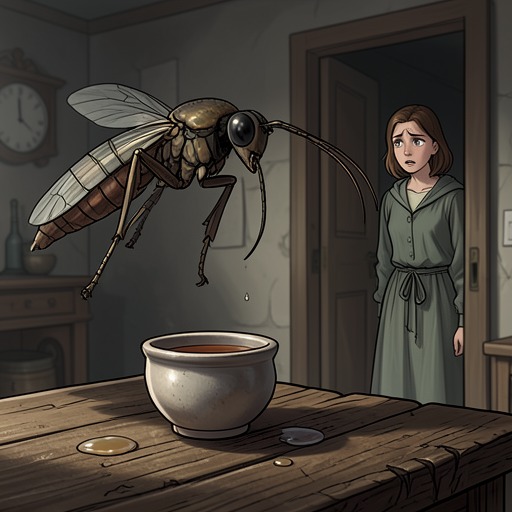
Food, appetite, and disgust
The MetamorphosisFood, appetite, and disgust are not incidental details in Metamorphosis: they provide one of the clearest measures of Gregor Samsa’s transformation and of the family’s changing response to him. Before the metamorphosis, Gregor’s bodily life is organized by work, travel, irregular meals, and the pressure to remain functional. Afterward, food becomes an experiment in identity. What once nourished him may repel him; what appears spoiled or refuse-like may become irresistible. As his appetite narrows, the family’s care becomes increasingly indirect, and his body is gradually understood less as a suffering person than as a problem of feeding, cleaning, and disposal.## Appetite Before and Immediately After the TransformationBefore the change, Gregor Samsa thinks of food chiefly through the hardships of his occupation as a travelling salesman. His work requires constant travel, difficult train connections, bad and irregular food, and a life among strangers. Hunger is therefore part of his ordinary work anxiety, but it remains the hunger of a human worker who expects to eat, travel, and report for duty. Even after waking transformed into a horrible vermin, he initially feels physically well apart from his unfamiliar body and says that he feels much hungrier than usual. His first practical priorities are still recognizably human: he wants to get out of bed, get dressed, and most of all have breakfast before deciding what to do next. He even interprets his altered voice as the beginning of a serious cold, an occupational hazard rather than evidence that his entire bodily identity has changed. Food thus briefly helps him preserve continuity with his former self, even as the body that should receive it has become difficult to control.\n\nThat continuity is immediately disrupted by the gap between appetite and bodily capacity. Gregor struggles to move his broad, armoured body and its many uncontrollable legs, while pain and unfamiliar sensations make even simple actions uncertain. His concern about food remains concrete, but his transformed body no longer obeys the routines that once made eating ordinary. Hunger survives the metamorphosis more readily than the human conditions that used to satisfy it.## Milk, Experiment, and the Discovery of a New AppetiteWhen Gregor wakes in the evening after his violent expulsion into his room, the smell of food draws him toward the door. Grete Samsa has left him a dish of sweetened milk with little pieces of white bread floating in it, evidently choosing it because milk had been his favourite drink. His response is first one of intense pleasure: he is even hungrier than he was in the morning and dips his head into the dish so eagerly that he nearly covers his eyes with milk. Yet the anticipated comfort collapses almost at once. The milk tastes unpleasant, and the pain in his tender left side makes eating difficult because his whole body must work together as a snuffling whole. He turns away from the food almost against his will. The dish records both Grete’s affectionate knowledge of the former Gregor and the failure of that knowledge to reach the transformed body.\n\nGrete’s next attempt is more attentive because it treats Gregor’s appetite as something that must be discovered rather than assumed. She removes the untouched milk with a rag and places a selection of foods on an old newspaper: old, half-rotten vegetables; bones from the evening meal covered in hardened white sauce; raisins and almonds; cheese that Gregor had declared inedible two days earlier; a dry roll; bread spread with butter and salt; and water in a dish set aside for his use. She leaves without watching him and turns the key in the lock so that he can eat in privacy, an arrangement that combines consideration with confinement. The meal becomes a test of taste, but it is also a test of whether any stable human identity remains beneath his altered appearance.\n\nGregor’s preference is decisive and disturbing. The cheese he had rejected as inedible only two days earlier attracts him almost compellingly, and he greedily consumes it, followed by the vegetables and the hardened sauce. Fresh foods repel him; he drags the things he wants away from them because he cannot stand their smell. His appetite has not vanished, but it now follows a logic that his former self would have found disgusting. At the same time, the pleasure of eating confirms that his body is not simply inert or dead. His injuries have already healed enough for him to move without difficulty, and the food briefly gives him physical satisfaction. The scene makes appetite a form of knowledge: Gregor learns what he has become through what his mouth accepts and what it rejects.## Feeding as Care, Privacy, and SeparationThe daily feeding routine turns Grete into Gregor’s intermediary with the family. She brings food once in the morning while his parents and the maid are asleep and again after the midday meal, when his parents sleep and Grete can send the maid on an errand. Gregor’s father and mother do not want him to starve, but they can bear to know about his feeding more easily than to witness it. Grete therefore protects them from the scene, while also protecting Gregor from being watched as he eats. Care is present, yet it is structured by avoidance. Food reaches Gregor, but the shared human table does not.\n\nThe disposal of leftovers makes that separation sharper. After Gregor eats, Grete returns, sweeps together what remains and what he has refused, mixes them together, and drops everything into a bin as though none of it can be used again. Gregor waits under the couch while she does this, then emerges as soon as she turns away. His feeding is consequently divided into private appetite and public removal: he consumes alone, hides from the person who feeds him, and witnesses his food being classified as waste. The family’s practical response is not openly cruel at first, but it steadily places Gregor on the far side of ordinary domestic exchange.\n\nThe meal also establishes a recurring contrast between Gregor’s needs and the family’s shrinking resources. His parents and Grete eat little and refuse to drink much, while their financial prospects have become uncertain after Gregor’s incapacity. The family’s old business has left some reserve money, but it can support them for only perhaps one or two years and must be preserved for emergencies; money for daily life must be earned. Gregor had previously worked to pay his parents’ debt and had converted his success into cash placed on the table at home. Now food exposes the reversal of that arrangement: the former provider is dependent on others for each dish, while those who depended on him must prepare themselves to work.## Hunger, Decline, and the Social Meaning of EatingGregor’s appetite gradually deteriorates. He almost entirely stops eating, and when he happens to find himself beside food prepared for him, he may put some into his mouth merely to play with it, leave it there for hours, and then spit it out. His loss of appetite is not presented as a single medical symptom with a diagnosis. It is bound to the conditions of his room, his reduced mobility, the family’s altered routines, and the increasing distance between his body and the household. The food remains available, but the act of eating no longer restores him to participation.\n\nThe room itself becomes increasingly associated with storage and degradation. Three bearded lodgers insist that the entire apartment be tidy, and objects that cannot be sold or discarded are placed in Gregor’s room along with kitchen dustbins. He first moves through the clutter because it leaves him no other place to crawl, then begins to enjoy the movement despite the exhaustion it causes. Food and refuse belong to the same expanding economy of displacement: the room receives what the household cannot accommodate, while Gregor receives what the household cannot comfortably witness. His appetite diminishes as his space becomes a repository for unwanted things.\n\nThe contrast becomes explicit when the lodgers eat at the family table. Their food is steaming meat and potatoes, served anxiously by Samsa’s mother and Grete, while the family themselves eat in the kitchen. The middle lodger inspects a piece of meat before accepting it, and the family waits for his approval. Gregor hears the lodgers’ teeth chewing and concludes that teeth are necessary for eating and that his toothless jaws cannot perform what theirs do. His hunger is therefore intensified by exclusion from the table, but the object of his desire is not simply the lodgers’ food. He wants to eat something, yet not what they are eating; even at the point of starvation, appetite retains a distinction between nourishment and disgust. The household’s social hierarchy is expressed through food: the paying lodgers occupy the table, the family serves them, and Gregor remains a hidden body nearing death.## Disgust, Injury, and the Final Recognition of DeathThe apple lodged in Gregor’s flesh remains for more than a month as a visible reminder of his father’s attack. His injuries permanently reduce his mobility, and the family’s attitude toward him becomes suspended between revulsion and obligation. The wound forces recognition that Gregor is still a family member who cannot simply be treated as an enemy, yet that recognition does not restore ordinary care. The apple is both a physical object embedded in his body and a sign of the family’s unresolved relation to him: disgust must be swallowed, patience must be maintained, and the injured body must remain inside the apartment.\n\nBy the end, appetite has become the most direct evidence of Gregor’s physical deterioration. Grete observes that he had not eaten for so long, and when the family sees his corpse, his body is completely dried up and flat. The food comes out again just as it went in, confirming that eating has ceased to sustain him. His death is not discovered through a dramatic medical explanation but through the ordinary domestic signs of an abandoned body: the cleaner announces that he is dead, the family enters his room, and the visible remains of feeding reveal how long his decline has lasted. What began as a question of taste ends as evidence of bodily extinction.\n\nAfter Gregor’s death, the family can finally leave the apartment together, take the tram into the open country, and discuss their jobs and prospects. They discover that all three have work with promise and begin considering a smaller, cheaper, more practical flat. Their return to movement and future planning follows immediately upon the removal of Gregor’s starving body. Food, appetite, and disgust therefore trace not only his transformation but the household’s reorganization: the family’s economic and social life becomes viable again once Gregor’s need for care no longer governs it.